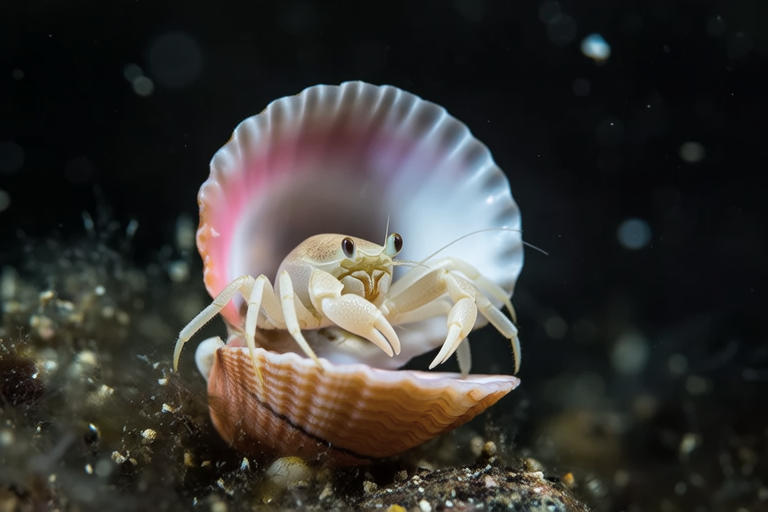
Life Inside Out: How Pea Crabs Thrive Within Mollusks
In the vast and diverse world of marine life, one might not immediately think of crabs as creatures that live inside other animals. Yet, there exists a fascinating group of crustaceans known as pea crabs, which have adapted to a unique lifestyle: living inside mollusks. This article delves into the intriguing world of pea crabs, exploring their symbiotic relationship with their hosts, the anatomical adaptations that enable their survival, and the geographical distribution of these partnerships.
The Unique Living Arrangement of Pea Crabs
Pea crabs, belonging to the family Pinnotheridae, are tiny crabs that inhabit the mantle cavities of various bivalve mollusks, including oysters, clams, and scallops. These crabs are named for their small size, typically ranging from a few millimeters to a few centimeters in length, resembling peas. Their choice of habitat is not merely shelter; it is a carefully evolved arrangement that benefits both parties involved. The crabs enter the mollusks through the siphons, which are openings used by the mollusks for feeding and respiration.
Symbiotic Relationship Between Pea Crabs and Their Hosts
The relationship between pea crabs and their hosts is often described as commensal, where one organism benefits without affecting the other. However, in many cases, it can be considered mutualistic, meaning both organisms benefit from the association. For the pea crab, the bivalve provides protection from predators and a stable environment rich in nutrients. In return, while the crabs do not directly harm the host, they may consume some of the food particles filtered by the mollusks, potentially influencing the host’s diet but not necessarily in a detrimental way.
For instance, when a pea crab lives within an oyster, it benefits from the constant supply of plankton and organic debris that the oyster filters from the water. This food source is readily available and ensures the crab’s nutrition. Additionally, the protective shell of the oyster shields the pea crab from external threats, making it a safe haven.
Anatomical Adaptations of Pea Crabs
To thrive within the confined space of a bivalve’s mantle cavity, pea crabs have developed several remarkable anatomical adaptations. One of the most notable is their flattened body shape, which allows them to maneuver efficiently within the limited space. Their legs are also shorter and more robust than those of their free-living relatives, enabling them to grip onto the host’s tissues securely. Moreover, pea crabs lack the powerful claws typical of other crab species, instead possessing smaller pincers that are more suited for handling the soft tissues of their host.
Their reproductive organs are also adapted to their enclosed environment. Female pea crabs carry their eggs externally, attaching them to their bodies until they hatch. This adaptation ensures that the offspring are protected within the safety of the host’s shell, increasing their chances of survival.
Specific Examples and Geographical Distribution
Pea crabs can be found in a variety of bivalve species across different parts of the world. One well-known example is the Pinnotheres ostreum, commonly found in European waters, particularly within the common oyster (Ostrea edulis). Another species, Pinnixa faba, inhabits the blue mussel (Mytilus edulis) along the Atlantic coast of North America. In Asia, the Pinnotheres sinensis is known to reside within the Pacific oyster (Crisia gigas).
The geographical distribution of these symbiotic relationships is widespread, spanning from temperate to tropical regions. While pea crabs are predominantly found in coastal areas where their hosts thrive, their presence can vary depending on local environmental conditions, such as water temperature and salinity.
Challenges Faced by Pea Crabs and Overcoming Them
Living within a mollusk presents several challenges for pea crabs. One significant challenge is the limited space and resources within the host’s mantle cavity. To overcome this, pea crabs have evolved efficient feeding strategies, maximizing the use of available food particles. They are adept at scavenging the detritus and smaller organisms that accumulate within the cavity, ensuring they obtain sufficient nutrients.
Another challenge is the potential for conflict with the host over resources. However, studies suggest that the impact of pea crabs on their hosts is minimal. The crabs do not significantly alter the host’s physiology or behavior, and their presence does not lead to a decline in the host’s health. This coexistence is likely facilitated by the crabs’ ability to regulate their own consumption, avoiding overexploitation of the host’s resources.
The Importance of Studying Symbiotic Relationships
The study of pea crabs and their symbiotic relationships with bivalves provides valuable insights into broader ecological systems. Understanding these interactions can help us comprehend the complex dynamics within marine ecosystems and the roles played by different species. For instance, the presence of pea crabs can influence the population dynamics of their hosts and the surrounding ecosystem, as the crabs can serve as a food source for larger predators.
Moreover, these relationships highlight the adaptability and resilience of marine organisms. By examining how pea crabs have evolved to thrive within their hosts, scientists can gain a deeper understanding of evolutionary processes and the mechanisms that drive adaptation. This knowledge is crucial for conservation efforts and sustainable management of marine resources.
In conclusion, the life of pea crabs within mollusks offers a captivating glimpse into the intricate web of life in the ocean. Their unique lifestyle, characterized by a mutually beneficial relationship with their hosts, showcases the remarkable adaptability of marine organisms. By continuing to explore these symbiotic relationships, we can enhance our understanding of marine ecology and contribute to the preservation of these vital ecosystems.
